The DIY Question
A sagging panel or a door that won't budge tempts most owners to grab a wrench before they call anyone. Some of that is fine - lubricating hinges, tightening loose bolts on the track brackets, clearing a sensor that's caught a cobweb. None of that needs a truck.
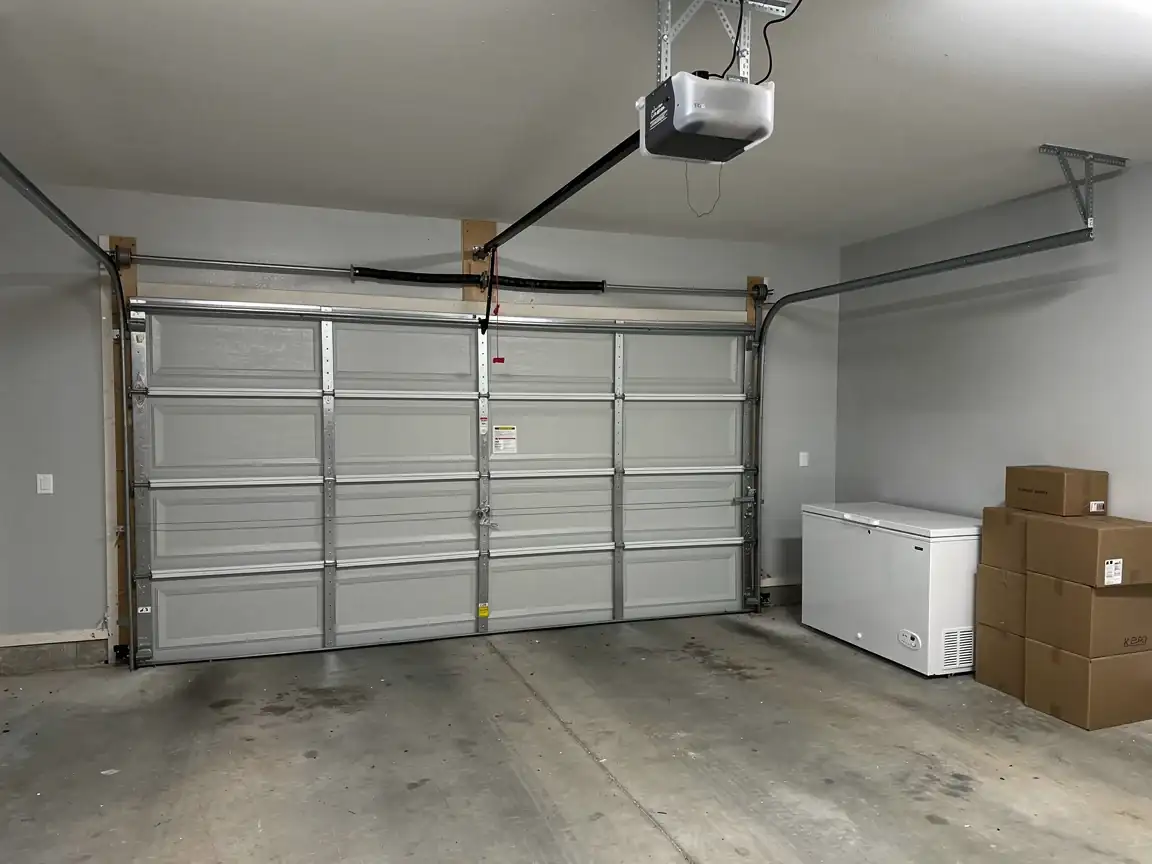
A torsion spring is a different animal. It's wound under enough tension to break bones, and on the original hardware still bolted to a lot of houses in this area, that spring has been doing its job since the house was built or close to it. If the door won't open, the cable has jumped the drum, or one side of the door hangs lower than the other, that's not a tightening job - that's a hardware failure under load.
Here's the honest limit: if you're not sure whether what you're looking at is a spring, a cable, or just a misaligned track, don't start unbolting anything. We'd rather walk you through what's safe to check over the phone than show up to a job that got worse because someone released tension on a spring that wasn't wound the way they thought.
Why It Happens Here
Housing in this part of the service area was mostly built between 1951 and 2012, with the median landing around 1977 - which puts a huge share of the 21,635 owner-occupied houses here squarely in 1960s and '70s construction. That generation of garage doors came with torsion springs rated for a working life measured in cycles, not years, and most of those original springs have long since passed their expected count.
Add a cold-moderate climate to that equation. Steel contracts in winter, and the grease on an original-era roller or track that hasn't been serviced in decades gets stiff right when the door is doing the most work of the year - holiday traffic in and out, cars warming up, kids slamming the walk-door next to it. A spring that's already fatigued from 40-plus years of cycles doesn't need much of a cold snap to finally let go.
Newer builds in the area, especially anything from the 1990s or 2000s, tend to have factory-upgraded galvanized springs and better-sealed bottom panels, so the failure pattern skews heavily toward the older stock - which is most of what's out there.
The Symptom
The door that won't lift evenly
One side climbs while the other stays put, or the whole panel racks sideways in the track - is almost always a spring problem, not an opener problem, even though the opener usually gets blamed first. On a double door with two springs, it's common for only one to have broken, which is why the door looks like it's trying but failing rather than just sitting dead.
A loud bang from the garage, often in the morning when it's coldest
Is frequently the spring itself finally snapping under tension it's held for years. If you hear that and then can't lift the door by hand, that's confirmation - the spring was doing the lifting, and now nothing is.
Worn rollers show up differently
Grinding or popping as the door travels, especially on original steel rollers that were never swapped for nylon. That's wear, not failure, and it's a cheaper fix if caught before it damages the track itself.
A frayed or snapped cable usually shows up as a door that drops suddenly partway down
Or hangs crooked at the bottom. That's urgent - a door held by one cable can come down the rest of the way without warning.
Booking a Visit
We cover the stretch around Norcross out to Berkeley Lake, Doraville, Mountain Park, and the other communities in this corner of the county, where the same postwar-through-1980s building pattern shows up house after house. If your door is original to a house built in that window, there's a good chance we've already seen the exact spring size and mounting setup on the street next to you.
Tell us what you're hearing or seeing - a bang, a crooked door, a cable off the drum - and we can usually narrow down the likely cause before the truck even leaves. That matters because parts availability varies: some older torsion spring sizes aren't something we carry on every truck, and if yours is an odd one, it may mean a short wait rather than a same-day fix. We'd rather tell you that upfront than promise a timeline we can't hit.
Start with a call. A quick description of the symptom gets you a faster, more accurate visit than guessing.