
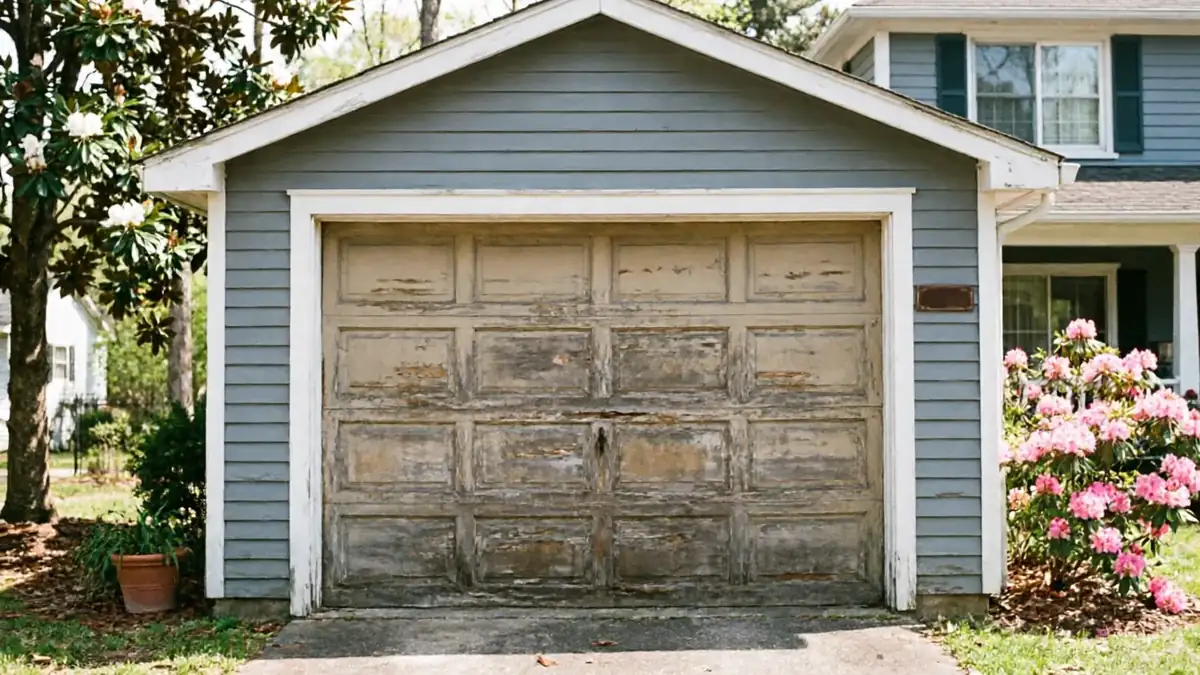
When to Get Help
Call before a small problem turns into a stuck car. A door that slams the last foot of travel, a spring that's visibly gapped or sagging, cables fraying at the drum, or an opener that reverses for no reason - those are the signals that something's about to fail outright, not wear out slowly. Given that housing in this service area was built mostly between 1951 and 2012 with a median around 1977, a lot of the original hardware out there is 45 to 70 years old. That's not a scare number, it's just math: steel fatigues, lubricant dries out, and the galvanizing on an old spring wears thin long before the door looks bad from the driveway. If your door is loud, slow to respond, or has started needing a shove to get moving, don't wait for the cable to snap with the car halfway out. A ten-minute look at the springs and track tells us a lot more than a phone description ever will, and it's cheaper to catch a worn roller than to replace a bent track after it jumps.
The Problem
Across the 18 communities in this service area, most of the housing stock is 1960s and 1970s construction, which means a specific kind of door: single-piece or early sectional, extension springs mounted along the horizontal track rather than the torsion bar setups standard in newer builds, and steel that's thinner gauge than what's made today. That hardware wasn't built to last 50 years, it was built to last 15 to 20 before somebody upgraded it - except plenty of owners never did. So when we get called out to a 1970s build, we're usually not looking at a worn part in isolation, we're looking at an entire system that's original to the house: springs, rollers, hinges, and track all aging together. Fixing just the spring on a door like that sometimes just moves the next failure to the cable or the hinge six months later. That's the honest version of 'the problem' here - it's rarely one part, it's a door system that's reached the end of its working life all at once.
What It Costs
I can't give you a number without seeing the door - a single broken extension spring on an older single-piece door is a different job than replacing a full torsion system on a sectional door that's rusted at the track brackets, and pricing depends on what's actually failed. What I can tell you is how to think about it: if the opener, springs, and track are all original and all showing wear, patching one part is often a short-term fix that just shifts the failure to whatever you didn't replace. At that point full hardware replacement usually costs less over two or three years than a string of individual repairs. On the other hand, if the door itself is sound and it's just a spring or a roller gone bad, fixing that one part is the right call and there's no reason to replace a door that's otherwise fine. Across the service area's 21,635 owner-occupied houses, most of the calls we get are exactly this judgment call, and it's one we make standing in front of the door, not over the phone.











