
When to Get Help
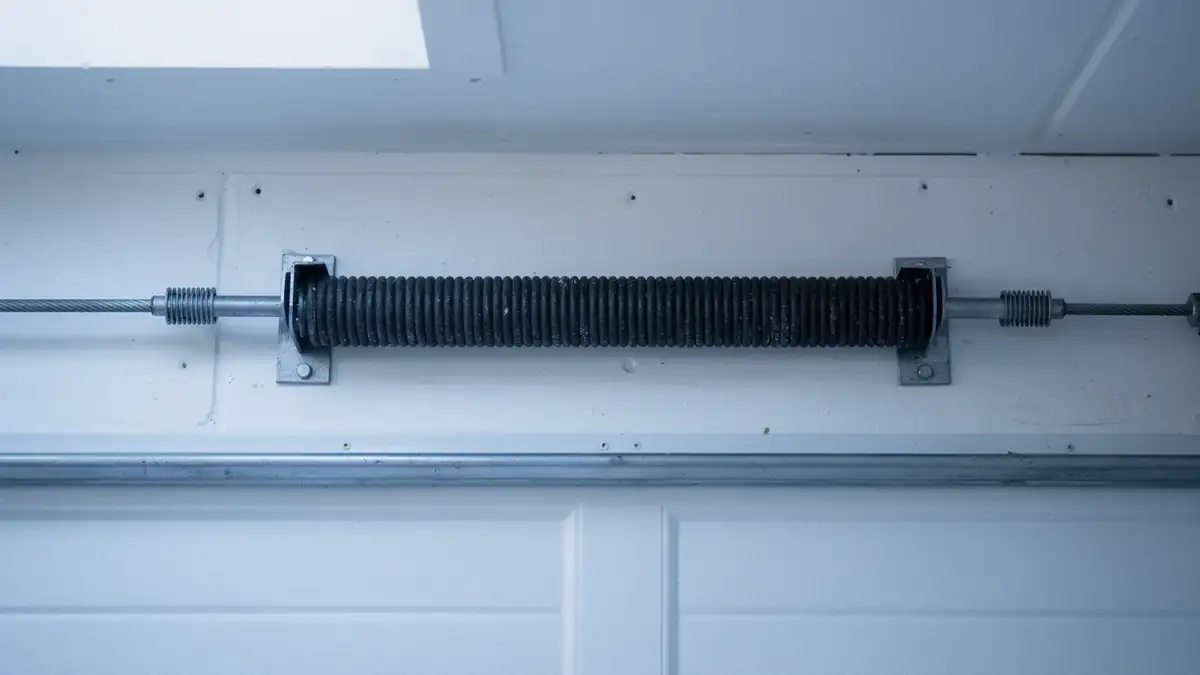
If your door won't lift, or it lifts a few inches and stops, that's almost always a broken torsion spring, not the opener. Don't keep hitting the remote - a motor fighting a dead spring will burn out trying. If you hear a loud bang from the garage on a cold morning and the door won't budge after, that's the spring letting go. Stop using the door, prop it manually if you need the car out, and call before you try to force it.
Same goes for a door that's noticeably heavier to lift by hand than it used to be, or one side that looks lower than the other when it's open. That's a spring losing tension before it snaps outright, and it's worth a look before it fails on you at 6am on your way to work.
One thing I won't do is talk you into a same-day panel swap when the fix is a spring and a service call. If the door itself is sound, replacing the spring is the job - nothing more needs touching.
The Problem
Most of the houses in this service area went up between 1951 and 2012, with the bulk of the stock dating to the 1960s and 70s across the eighteen named communities we cover. A lot of those original garage doors still run the torsion spring sizing that came with the house decades ago - steel that's been winding and unwinding for forty, fifty years.
Spring steel work-hardens over that many cycles. It gets more brittle with age, and the failure point is usually a cold morning, because cold steel doesn't flex the way warm steel does. A spring that's been sitting on borrowed time all summer can go the first hard cold snap of the season. It's not that cold weather breaks healthy springs - it's that it's the final push on a spring that was already near the end of its wind count.
The other factor is lubrication. Old grease on an old spring thickens up when the temperature drops, and a coil that doesn't flex smoothly under load is a coil under more stress per cycle. That's a maintenance issue more than an age issue, but on a house with a spring that's already thirty-plus years old, it's the difference between a slow fail and a sudden one.
How Local Conditions Play In
Norcross sits in a cold-moderate band
Not the deep freezes you'd get further north, but enough swing in temperature to matter for steel that's been in service since the Carter administration. The cold snaps here are short but real, and they tend to hit a spring that's already fatigued harder than a longer, steadier cold would.
Across the service area
From Berkeley Lake three miles out to Fair Oaks twenty miles north - you've got roughly 48,457 households and about 21,635 owner-occupied houses, a lot of them sitting on that same 1960s-70s original hardware. That's not a small number of doors running decades-old torsion springs through the same seasonal swing every year.
- 48,457 households
- 21,635 owner-occupied
What that means practically
The failures cluster right after the first real cold stretch, not during the deep summer heat when steel is more forgiving. If your spring has made it fifteen or twenty winters already, the next sharp cold morning is the one to watch for, not the hottest day of July.
What It Costs
I'm not going to quote you a number here without seeing the door - spring size, door weight, and whether it's a single or double torsion setup all change the job, and I don't have a flat rate to hand you sight unseen. What I can tell you is what drives the cost: whether it's one spring or a matched pair (if one side went, the other's usually close behind on a same-age door), and whether the drums, cables, or bottom brackets took damage when the spring snapped - which happens more often on heavier doors.
With a median household income of $73,075 across the area, most of the calls we get are repair-first, not replace-first - fixing the spring rather than swapping the whole door, as long as the door and track are otherwise sound. That's usually the right call on a door that's structurally fine and just lost its spring. Where it stops making sense is a door old enough that the track, rollers, and panels are all failing at once - at that point you're paying to patch something that's going to need the next part replaced in six months anyway, and a full door swap is the better money.











